| |
|
Bitcoin
|
|
Affairs
|
|
|
|
No. 080 · 15 Aug 2026
|
|
|
|
MARKET SNAPSHOT
|
BTC / USD
$63,087
|
|
24H CHANGE
+0.3%
|
|
| |
ALL-TIME HIGH
$124,749
|
|
FROM ATH
-49.4%
|
|
|
|
Trump set to join White House session with crypto and market-structure chiefs
|
|
People involved in next week’s White House innovation meeting say President Donald Trump is expected to attend alongside crypto, prediction-market and AI CEOs before the CFTC committee’s inaugural session. The lineup includes major industry and market-infrastructure firms, making the gathering an important signal for near-term U.S. crypto policy and the stalled Clarity Act debate.
|
| Regulation Macro |
|
|
|
Russia bans Moscow-area bitcoin mining through 2032 to protect strained power grids
|
|
Moscow, the surrounding region and parts of Kursk have banned crypto mining and mining-pool participation through Dec. 31, 2032 under a government decree aimed at preserving grid stability. The move tightens pressure in a country that represented an estimated 16.4% of global Bitcoin hash rate in the first quarter.
|
| Mining Regulation |
|
|
|
Israel’s largest bank will launch crypto trading through Galaxy in 2027
|
|
Bank Leumi said customers will be able to buy, hold and sell bitcoin, ether and solana through its Leumi Trade app from early 2027 using Galaxy’s trading and custody stack. The rollout would make it the first Israeli bank to offer direct crypto trading inside its own banking platform.
|
| Regulation Macro |
|
|
|
Paul Tudor Jones fund adds BlackRock bitcoin ETF shares despite hedging cuts
|
|
Tudor Investment raised its direct IBIT stake 18.9% to 688,529 shares as of June 30 while sharply cutting its reported call exposure and modestly trimming puts. The update matters because Paul Tudor Jones has consistently framed Bitcoin as an inflation hedge, even if the position remains far below its late-2024 peak.
|
| ETF Macro |
|
|
|
≡
|
COMMENTARY
VOICE FROM THE NETWORK
|
|
200 Ways To Make Money With AI
Turns out, AI is good for more than writing emails and generating LinkedIn posts. This guide is packed with 200+ actionable ways to build income with AI.
200 curated AI income ideas for beginners and pros alike
Easy-to-start opportunities you can launch this week
Real world applications for today’s top AI tools
AI powered business models built for today’s economy
Creative ways to turn trends into revenue
AI is changing how people work and how people earn, far beyond the simple “write me an email” prompt. Discover the possibilities and download the free guide to start cashing in today.
Let’s say you have $1M worth of bitcoin. There are a few common ways to secure it today:
1. Take full responsibility and self-custody with ~$200–$1,000 worth of hardware and no ongoing custody or subscription fee.
2. Use collaborative custody, where you hold the majority of the keys but a trusted third party helps with backup/recovery. Bitkey offers a version with no subscription, while other services can cost $200–$2,000/year.
3. Leave it with an exchange or brokerage for no explicit custody fee. You give up control and take counterparty risk. If the custodian fails, there’s no guarantee you’ll be made whole, and recovering customer assets through bankruptcy can be a long and uncertain process.
4. Convert it into an ETF like $IBIT and pay a 0.25% expense ratio, or $2,500/year at today’s exchange rate, potentially offsetting some of that cost by selling covered calls. Poor execution of this strategy can result in a loss of bitcoin denominated value though.
Self-custody isn’t free of risk. You’re taking responsibility for securing and recovering your own money, and mistakes can be costly.
But done correctly, you can secure large amounts of bitcoin for a relatively small upfront cost, retain full control of your savings, and never have to trust a third party with your keys or pay an annual fee for the privilege of securing them.
 12 reposts 23 replies 120 likes
|
|
🔥 INSIGHT: Crypto executives have been lying to you.
Bitcoin probably isn't going to $1 million by 2030.
In the latest episode of Trade Secrets, @itsciaranlyons sits down with Markus Thielen (@markus10x) of 10x Research (@10xresearch) to unpack why the $1M Bitcoin prediction may be more hype than reality.
"It's mathematically impossible," Thielen says.
So why do crypto execs keep pushing it anyway?
#TRADESECRETS
00:00 — Intro
01:00 — What Bitcoin metric are you most bullish on?
04:35 — Positive signs Bitcoin is making a low
08:45 — Will Bitcoin reach a new all-time high in 2027?
10:23 — Why Bitcoin returning to $100K would be a 'big achievement'
13:23 — Why Bitcoin mining is becoming less lucrative
17:28 — Has Strategy's sell-off added to Bitcoin market fear?
22:10 — Why $1 billion isn't enough to move Bitcoin's price higher
26:05 — How should you split $10K between Bitcoin, AI and gold?
30:00 — Is Bitcoin reaching $1 million by 2030 realistic?
34:00 — Why are crypto execs pushing the $1M Bitcoin prediction?
37:00 — Why Satoshis don't sound as good to investors as Bitcoin
42:00 — What will the next altcoin season look like?
 23 reposts 60 replies 133 likes
|
|
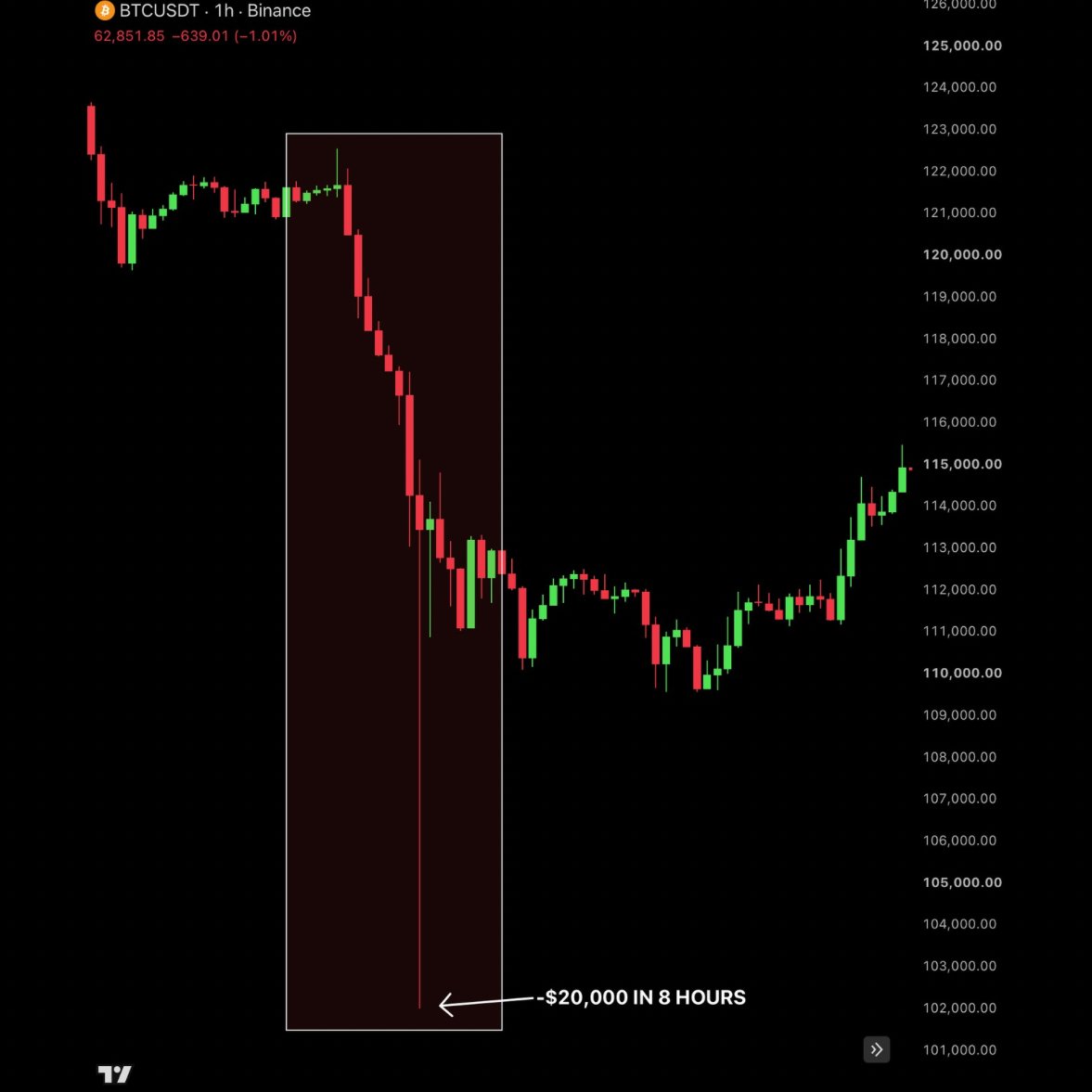
🚨 THE SAME CATALYST THAT CAUSED THE OCTOBER 10 CRASH IS BACK.
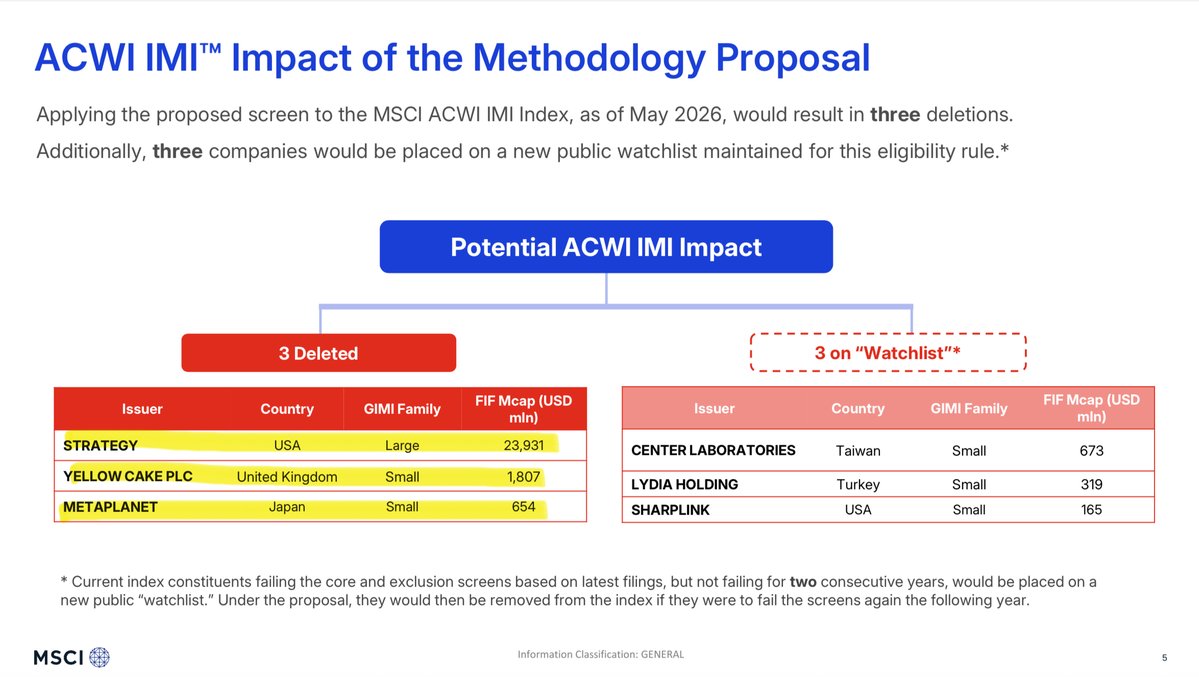
MSCI has brought back the proposal that would remove Michael Saylor's Strategy from every major global index.
The first time it did this, on October 10, Bitcoin dropped roughly $18,000 in one day and over $20 billion in liquidations happened.
MSCI wanted to remove any company holding 50% or more of its assets in crypto, and since MSCI indexes decide where trillions of dollars of passive money sits, funds started pricing in forced selling immediately.
MSCI dropped that plan in January after Strategy argued the crypto specific rule was arbitrary and unfair.
The new proposal fixes that. It does not target crypto at all.
MSCI has created a category called Non-Operating Companies. These are companies that make money by holding assets instead of running a business.
The first check is simple. If more than half of a company's assets are used to actually run a business, it stays in the index. If not, MSCI runs five more checks: how much it spends on operations, whether it burns cash, how much of its value swings with asset prices, and how much it depends on raising outside money to keep buying more assets.
Fail four out of those five and the company is removed.
MSCI already tested the rule on its main global index, ACWI IMI, using data from May this year. Strategy failed. So did Metaplanet and uranium holder Yellow Cake.
SharpLink is one step behind them. It failed the test once, and one more failure next year removes it too.
That is the problem for Saylor. His entire defence last time was that MSCI was targeting crypto. He cannot use that when a uranium company fails the same test.
If it passes, every fund tracking MSCI has to sell Strategy on the same day. JPMorgan put that number at $8.8 billion when it modelled the October version.
 |
|
 |
183 reposts 154 replies 1.1K likes
|
|
Bitcoin has slipped just under its 200 week moving average 👀
Price: $62,574
200 WMA: $63,891
That's -2.1%, and the FOURTH day running below it.
- - -
The 200WMA is the slowest and most boring line in all of Bitcoin analysis. That is precisely why people watch it. It takes nearly four years of price action to move, so this week's news barely registers at all.
In twelve years, price has closed under this line on ONLY 8.5% of days, friends.
Keep your head up. 🟠
 19 reposts 15 replies 232 likes
|
|
BITCOIN is about to EXPLODE:
Bitcoin is sitting around $63k, down roughly 50% from the ATH, basically stapled to its 4-year moving average.
So I ran 20,000 historically conditioned Monte Carlo paths from here.
The model uses actual historical Bitcoin return blocks and conditions on the kind of state we’re in now:
BTC near its 4-year MA
90-day return deeply negative
drawdown near 50%
realized volatility compressed
long-term moving average still rising
Then I asked a simple question:
What tends to happen next if Bitcoin behaves like Bitcoin?
Here’s the raw 24-month distribution:
10th percentile: $79K
25th percentile: $108K
Median: $179K
75th percentile: $255K
90th percentile: $402K
Median outcome: $63K → $179K
That’s roughly a +183% total return (68% CAGR)
In the middle of a bear market.
While everyone is currently examining a -2.7% candle like the Warren Commission examining the Zapruder film.
The path to those outcomes is also aggressively Bitcoin.
Across the simulations:
93.3% suffer a 30%+ drawdown somewhere along the way.
Median maximum drawdown: -42.7%
So the model is basically saying:
“Congratulations. You may become much richer. First, however, Bitcoin would like to put your nervous system in a Home Depot paint shaker.”
The simulation practically expects emotional property damage.
But when I look at this distribution, the question becomes less:
“What if Bitcoin drops again?”
and more:
“What if this is the part everyone remembers later as obvious?”
Bear markets are where conviction gets tested.
Sometimes they’re also where the future CAGR is quietly being manufactured while everyone else is refreshing the chart and developing a magnesium deficiency:
 51 reposts 61 replies 552 likes
|
|
Bitcoin is 87% correlated to global liquidity. The NASDAQ is 97% correlated.
Which tells you something most people never realise. These assets are not really trading on earnings, or news, or whatever the story of the week is. They’re tracking the amount of money in the system.
Bitcoin just swings harder around that line, because on top of liquidity it is young, volatile, emotional, and still riding a network adoption curve. Sometimes it runs hot. Sometimes it runs cold. Right now it is running cold, so people think something is broken.
Nothing is broken. It’s doing exactly what it always does.
So here is the question. If these assets track liquidity this closely... what if t you could forecast liquidity itself?
Well, actually, you can.
As I lay out in my Everything Code framework, liquidity is driven by the debasement of currency, and debasement can be forecast years ahead, because the interest payments that drive it are already known today and they lead liquidity by around three years.
Bonkers.
 256 reposts 206 replies 2.4K likes
|
|


