| |
|
Bitcoin
|
|
Affairs
|
|
|
|
No. 169 · 12 Nov 2026
|
|
|
|
MARKET SNAPSHOT
|
BTC / USD
$72,533
|
|
24H CHANGE
-1.7%
|
|
| |
ALL-TIME HIGH
$124,749
|
|
FROM ATH
-41.9%
|
|
|
|
MSCI removes Strategy and Metaplanet from key indexes
|
|
MSCI’s November review will remove Strategy from its USA Index and Metaplanet from its Japan small-cap benchmark effective November 30. The change matters because index deletion can reduce passive exposure to listed Bitcoin treasury names just as equity investors are reassessing crypto-linked proxies.
|
| Macro |
|
|
|
US spot Bitcoin ETFs post another $299.8 million daily outflow
|
|
U.S. spot Bitcoin ETFs recorded a combined $299.8 million net outflow for November 11, with BlackRock’s IBIT accounting for $269.7 million of the redemptions and only Hashdex posting a net inflow. The latest reading keeps one of Bitcoin’s clearest institutional-demand gauges under pressure as the market heads deeper into November.
|
| ETF Macro |
|
|
|
Ukraine peace push stalls as U.S. envoys head to Putin
|
|
U.S.-mediated talks between Russian and Ukrainian delegations ended without a major breakthrough, and American envoys then traveled to Moscow to brief Vladimir Putin. With no clear path yet to a ceasefire, war-related energy, sanctions and risk-premium channels remain live inputs for the macro environment Bitcoin trades in.
|
| Geopolitics Macro |
|
|
|
BNY expands digital-asset custody stack with institutional staking through Figment
|
|
BNY said it will use Figment’s validator infrastructure so eligible institutional clients can stake supported assets directly from the bank’s existing custody platform, starting with ETH and later SOL. While not a Bitcoin-native catalyst, the partnership shows large traditional custodians are still expanding regulated crypto plumbing for institutions.
|
| On-chain Regulation |
|
|
When Postgres analytics slow down, most teams add a second database. Then comes sync lag and drift. TimescaleDB extends Postgres instead: analytics on live data, no pipeline. Get $1000 to start.
|
≡
|
COMMENTARY
VOICE FROM THE NETWORK
|
|
In partnership with

Ever wonder how they afford that? Check the receipts.
Admit it. You’ve wondered, how much money do they make?
Money is our last true taboo. We talk about therapy and bad dates, but guard our bank statements like classified files.
In every episode, real people share their actual, unedited transaction histories. You'll hear about the secret credit card debt, the reckless impulse buys, and the hidden sacrifices nobody talks about at brunch.
It’s revealing, intimate, and strangely validating to finally hear the truth behind other people’s bank accounts.
BREAKING: Global index fund giant MSCI just announced it will exclude Strategy $MSTR from its indexes as a non-operating company.
Michael Saylor previously said MSCI's decision "is not that important to us." 👀 https://t.co/ti78mI7vLl
12 reposts 16 replies 115 likes
|
|
JUST IN: 🇮🇱 $150 billion Israel Discount Bank will become the 1st bank in Israel to let customers buy, hold and sell Bitcoin 👀
Adoption! 👏 https://t.co/gwKBy17cSf
192 reposts 154 replies 1.4K likes
|
|
Today irrefutable evidence was discovered that @Ledger is not a cold wallet.
Evidence indicates that @Ledger devices send signals to @Ledger allowing @Ledger to store information that can compromise the safety and security of your private keys.
I have been saying this for years, but now it has been proven.
53 reposts 51 replies 306 likes
|
|
I underestimated Bitcoin’s risk to quantum.
Initially, it seemed like a problem that was still far away. Surely the smart people in the Bitcoin community would figure it out before it became urgent.
But after spending more time researching it, it became clear that the challenge is more complicated.
We’re now faced with some difficult questions:
- Which PQ signature scheme should Bitcoin adopt?
- How should users migrate?
- What happens to lost or dormant coins?
- How does the network reach agreement on an upgrade?
Bitcoin has no company or foundation that can mandate an upgrade. That decentralization is one of its greatest strengths, but it also makes a coordinated migration difficult.
Choosing an approach, building it, reaching consensus, and migrating users could take years.
So what are we doing about it?
At Stacks Labs, we’ve formed an R&D team focused on three initial priorities:
1. Make Stacks quantum-resistant
2. Study how to protect the Bitcoin backing sBTC
3. Contribute research and proposals that can support Bitcoin’s transition to PQ
As a first step, we completed an sBTC transfer on Stacks mainnet using Lamport signatures, a hash-based signature verified in Clarity.
This is an early PoC. We’re still evaluating potential signature schemes and what a broader transition would require. We’ll share more about this research and the broader Stacks quantum roadmap soon.
8 reposts 9 replies 91 likes
|
|
35.4% of all #BTC (7.12M) has a visible public key, the part a future quantum computer could target.
25.8% of supply is exposed due to address reuse, 11.6% on exchanges. Moving those coins to a fresh address ends this exposure.
Charts now live in Studio: https://t.co/jN0cPT4I84 https://t.co/tAJd8jUOUU
 22 reposts 47 replies 233 likes |
|
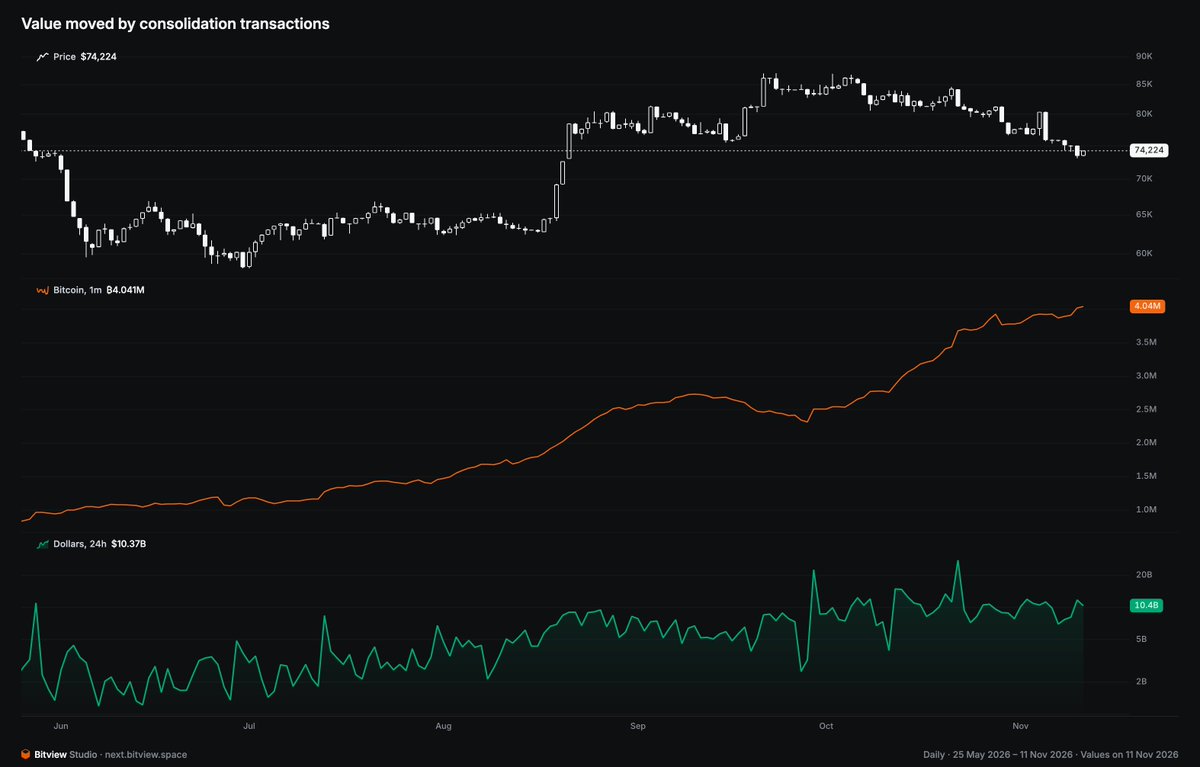
There may be a link between the share of addresses estimated to still be exposed because of address reuse and the fact that UTXO consolidations keep rising.
On a monthly basis, an average of 4 million BTC has been moved to consolidate UTXOs.
Almost a historic record.
In daily value terms, we are at roughly $10B moved every day by this type of transaction, on average 3 to 4 times more than at the beginning of the year.
This raises the question of whether the largest BTC holders (entities, exchanges and some whales) are upgrading the security of their Bitcoin.
These transactions often aim to move funds from an address holding many UTXOs, and therefore reused several times, to a new address whose public key is not exposed.
With the development of AI and quantum computing, there is no doubt that on-chain hygiene must become cleaner and cleaner to limit risks as much as possible.
To understand the issue, the most fragile addresses were the legacy ones, which were the only type available in the early days of Bitcoin.
Those first addresses, including the one belonging to Satoshi Nakamoto, were P2PK addresses. Today, only about 217 552 of them are believed to remain, of which only 38 066 still hold BTC.
This type of address is vulnerable because the public key is revealed as soon as funds are received.
For technological and security improvements, several new address formats were introduced later. Most of them keep the public key hidden until funds are actually spent.
However, Taproot addresses share the same fundamental exposure as legacy addresses once the public key is revealed.
In short, it is important to avoid reusing the same addresses, as well as Taproot and legacy addresses, to limit risk as much as possible.
This may be exactly the transformation the Bitcoin network is going through.
 2 reposts 4 replies 15 likes |
|