| |
|
Bitcoin
|
|
Affairs
|
|
|
|
No. 143 · 17 Oct 2026
|
|
|
|
MARKET SNAPSHOT
|
BTC / USD
$81,452
|
|
24H CHANGE
-1.0%
|
|
| |
ALL-TIME HIGH
$124,749
|
|
FROM ATH
-34.7%
|
|
|
Solana's price collapsed. Its network didn't. Dormant wallets are waking up, inflation is falling, and Firedancer is rolling out. Stop guessing the bottom. Get our full thesis, metrics, and risks.
|
Strive’s bitcoin buying surge wins TD Cowen upgrade as treasury race accelerates
|
|
TD Cowen raised its target on Strive after the bitcoin treasury company lifted holdings to 35,595 BTC, surpassing the analysts’ prior fourth-quarter accumulation forecast in just two weeks. The company’s planned $630 million preferred-share raise could fund additional purchases without issuing more common stock, reinforcing the corporate-treasury bid for bitcoin.
|
| Macro |
|
|
|
Trump freezes new Russia sanctions, muddying oil outlook and broader risk pricing
|
|
President Donald Trump signed an executive order pausing a sweeping new sanctions package on Russia just before the law’s implementation deadline. For Bitcoin markets, the key implication is macro: softer pressure on Russian energy flows muddies the oil and inflation outlook at a time when war-related shocks are already feeding into risk pricing.
|
| Geopolitics Macro Rates |
|
|
|
Iran war’s fuel pass-through keeps consumer inflation risks alive for markets
|
|
An Associated Press report said the Iran war is still lifting U.S. fuel, travel and goods costs more than seven months into the conflict, with some businesses still absorbing part of the hit. That matters for Bitcoin because prolonged energy-driven price pressure can keep inflation sticky and make it harder for the Fed to turn dovish.
|
| Geopolitics Macro Rates |
|
|
|
≡
|
COMMENTARY
VOICE FROM THE NETWORK
|
|
In partnership with

Built for the unstoppable.
The Dell Pro powered by Intel® Core™ Ultra with Intel vPro® adjusts power usage based on how you work, so your battery life never slows you down.
CLAUDE FOUND THE SEEDS
https://t.co/m8N6OPQoCQ
987 reposts 266 replies 8.6K likes
|
|
HOLY SHIT.
For crypto, this is one of the most insane posts of the year, but I'm guessing most people don't understand it.
Let me explain...
Bitcoin's accounts, and subsequently Ethereum's (and therefore every other EVM chain's), are built on a specific elliptic curve called secp256k1.
secp256k1 is a different elliptic curve from the one used across nearly every modern hardware device, including iPhones.
Modern devices mostly use a different curve called secp256r1, which is usually referred to as P-256 - one of the curves investigated in the article.
This mismatch has made it sooo difficult in the past to integrate crypto accounts natively into the security systems of modern hardware.
For example, Apple's Secure Enclave natively supports P-256, not secp256k1.
This has prevented crypto accounts from being able to use the same hardware protection as things like Apple Pay.
Same goes for the web with passkeys - WebAuthn uses P-256 signatures, which means Ethereum accounts using secp256k1 can't use them natively either.
But why did Satoshi do this?
The main theory for choosing secp256k1 was distrust of the P-256 curve - i.e. he thought there was an NSA backdoor.
A "backdoor" here basically means a secret, intentional weakness in the curve that would allow the NSA to exploit it and access private keys.
This was because P-256 was created with involvement from the NSA...
And the NSA provided a mysterious "seed" used to generate one of the curve's parameters without explaining where that seed came from.
This eventually transformed into a ~25-year-old mystery with a 5-figure reward for finding where this seed came from.
Claude figured it out in less than 30 mins.
And the best part is its internal thinking was: "Hmm wait... is it suspicious that such an obvious thing wasn’t discovered in 25 years?"
The solution was stupidly simple - just the time the curve was created, put into a specific random number generator function.
This doesn't 100% prove there's no backdoor yet, but it provides strong evidence that this seed wasn't secretly engineered by the NSA.
And Claude did this with "just a simple prompt" in under 30 minutes.
126 reposts 78 replies 1.8K likes
|
|
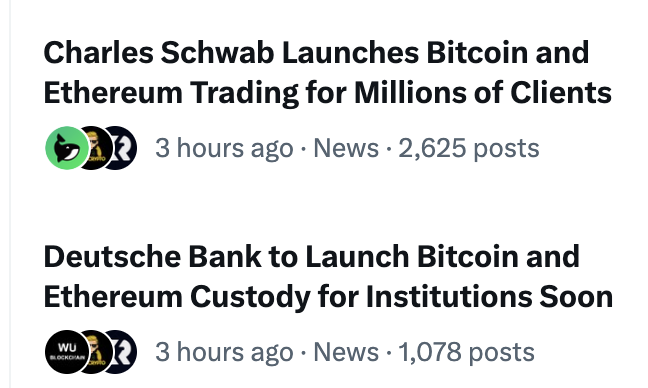
The institutions really are coming. https://t.co/nK2f9VGuxT
 81 reposts 29 replies 693 likes
|
|
Buying pressure from U.S. institutional investors is gradually weakening.
Bitcoin's price is rising, but institutional buying strength is fading a classic divergence.
This looks quite similar to what we saw back in April and May this year. https://t.co/45E3aBV8VT
 15 reposts 12 replies 175 likes
|
|
THIS IS INSANE
Bitcoin remains strong at $80,000 despite a series of bad news.
1. US Inflation is soaring, nearly double the Fed’s target of 2%.
2. The Fed raised interest rates by 25bps in September meeting and remains hawkish.
3. Top crypto researcher, Justin Drake warned AI could break cryptography protecting funds in wallets.
4. The US government moved $1.3 Billion in seized BTC, sparking selloff fears.
5. The US-Iran conflict keeps oil above $95.
6. The Dollar Index hit its highest level in 17 months.
Earlier when tech stocks fell in past cycles, crypto crashed much harder.
This time crypto holding strong.
82 reposts 71 replies 699 likes
|
|
Most people can’t see the bigger picture. https://t.co/0ZYHPJUjJo
 65 reposts 30 replies 445 likes
|
|


